If you’re looking to diversify in 2026, starting a concrete lifting business may sound enticing. However, it involves more of an investment than just buying a truck. Professional concrete lifting businesses require real liquidity to manage high startup and recurring costs.
This guide details the startup costs for a full polyurethane rig setup and explores how you can maximize your concrete lifting profit margins.
Concrete Lifting Polyurethane Business Startup Cost
Traditional mudjacking is a common method, but investing in polyurethane foam jacking offers numerous long-term advantages. While the initial investment might be higher, polyurethane’s durability, precision and lighter weight often lead to greater customer satisfaction and higher profit margins.
There are various costs you need to consider when starting a polyurethane business, including:
- Truck: You’ll need a suitable vehicle to mount a rig or pull a trailer, such as a van or a pickup truck.
- Rig: Quality polyurethane equipment is specialized. There are proprietary tools, like foam injection guns, which are worth investing in to ensure precision and efficiency.
- Training: Taking a class can teach you everything from estimating and bidding on jobs to maintaining equipment. A two-day discovery training seminar is $595.
- Initial materials: The cost of materials is around $2.30 per pound, but may vary.
- Administrative: Factor in accounting costs, phone bills and other necessary admin expenses.
- Marketing launch: To find jobs, you need leads. Spending around 5% of your total revenue on marketing is a good place to start.
The table below shows industry estimates for what you can expect to pay to start a concrete lifting business using a polyurethane rig. The bottom line is that the startup costs are high. However, this business isn’t a side hustle. Starting a polyurethane concrete lifting business requires serious capital.
The costs are based on a standard work year of 200 working days, to account for some downtime. Assuming you can get four jobs a day, making $1,200 per job, you’ll make $4,800 in revenue a day.
| Expenses | Estimated Daily Cost |
|---|---|
| Equipment financing | $90 a day |
| Marketing budget | $240 a day |
| Administrative | $100 a day |
| Fuel | $50 a day |
| Total daily cost | ~$480 a day |
With these costs in mind, your first year in a concrete lifting business could set you back around $96,000 at a daily cost of $480 across 200 working days.
This initial outlay often focuses on getting equipped for common, entry-level projects. For a startup, typical projects would primarily involve residential work like lifting sunken driveways, sidewalks, patios and garage floors, as well as smaller commercial slabs creating trip hazards.
While your business might eventually scale to tackle more complex challenges like foundations or infrastructure, that kind of growth typically happens after gaining significant experience and capital.
Recurring Costs
Recurring costs can also affect concrete lifting profit margins. In addition to general liability insurance, you’ll need pollution or environmental riders, since you’re injecting material into the ground. This specialized insurance can be higher than standard contractor insurance.
You also need to monitor your customer acquisition cost. Buying a polyurethane rig setup and paying for an initial marketing campaign is just the start. You have to budget for local ads and lead generation as a monthly cost. In areas with more competitors or during busier seasons, you may need to scale your marketing costs to compete.
Your cost of goods sold is another variable to consider. While a job could hypothetically bill for $1,500, you have to account for the $200 to $300 in chemical materials used.
Another high recurring cost is salary. If you’re an owner-operator, you can lower your overhead by doing all the work yourself. But if you’re running a crew or plan to scale up in the future, you’ll need to factor in regular wages.
Is Concrete Lifting Profitable?
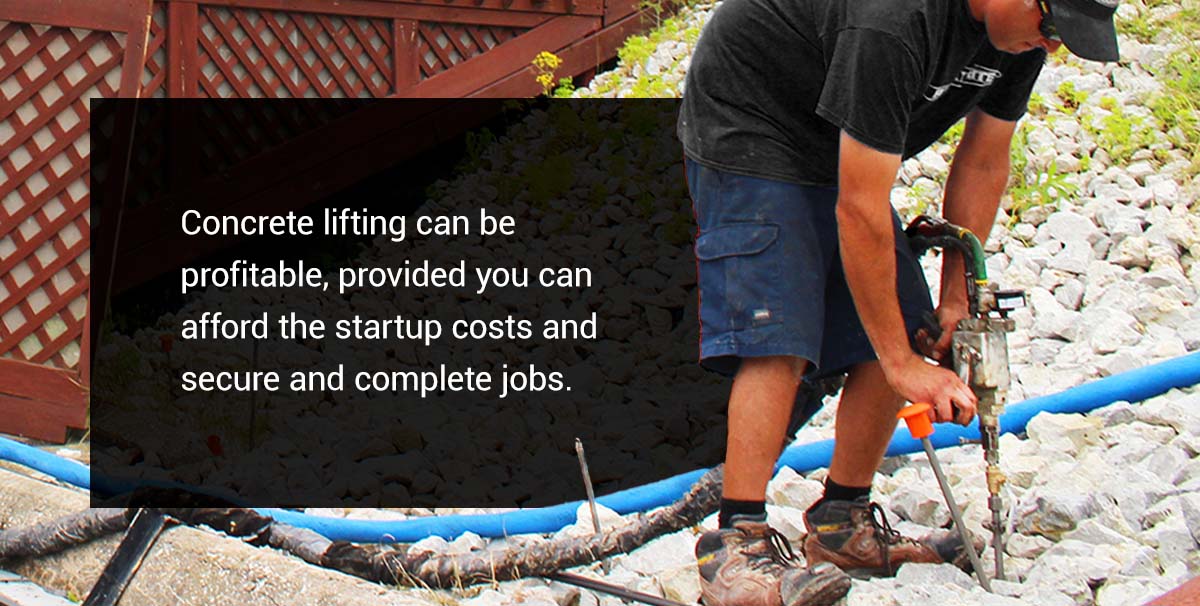
Concrete lifting can be profitable, provided you can afford the startup costs and secure and complete jobs.
Using these estimates(mileage will vary with experience and market! please modify for your individual case), you could earn $680,000 in net income per year with a successful concrete lifting business. This figure is based on the assumptions listed in the table above. The total revenue earned will vary from one concrete lifting business to another. You can calculate this number yourself by deducting your daily costs from your daily revenue.
For this figure, we calculated potential gross revenue at $4,800 a day, subtracting materials and other expenses to reach a net figure of $3,400 a day. This calculation works out at a net margin of roughly 70%, assuming you’re an owner-operator.
Even in a tightening economy, there are still profits to be made in concrete lifting. Homeowners may lack the funds to invest in a brand-new driveway. Instead, they’re prepared to spend less to lift and stabilize their existing one.
There’s market demand for concrete lifting, especially in the infrastructure sector. The American Society of Civil Engineers gave U.S. infrastructure its highest-ever grade of a ‘C.’ But there’s still a $3.7 trillion gap between planned infrastructure works and what needs to be done to get infrastructure in good working order. Some areas even scored lower, such as roads. There are potential jobs in concrete lifting, especially when it comes to governmental contracts.
Financing
While you need significant capital to start a concrete lifting business, there are financing options. You can work with a specialized lender, increasing your likelihood of getting financial help with some of your costs.
Concrete leveling equipment financing can help you keep your costs predictable. Rather than paying thousands for a new rig up front, you can pay back those costs over time, which frees up capital for other uses in your business.
A dollar buyout lease can help you own your equipment while reaping tax benefits. At the end of the dollar buyout lease, you may be able to claim Section 179 depreciation on the full value of your equipment immediately — consult with a CPA for financial advice.
Consider purchasing your equipment and materials directly from a trusted manufacturer. This option can be more profitable than partnering with a franchise. You can get equipment, training and financing support without franchise fees affecting your take-home pay.
Why Trust Us?
At HMI, we have over five decades of experience as a comprehensive solutions provider. We manufacture some of the industry’s best polyurethane equipment and materials to meet a range of residential, industrial and governmental applications. We design our foams and equipment for speed, precision and cost-effectiveness.
We aren’t a franchise. You can find all the tools and materials you need to start your concrete lifting business and boost your profit retention by avoiding franchise fees. We can also provide comprehensive training to help you get started, plus end-to-end engineering support for more complex jobs. You can even get leads, website reviews and other marketing resources from our marketing team.
Get Your Concrete Raising Business Off the Ground
The cost to start a concrete lifting business is steep — but the ROI you could achieve makes concrete lifting a profitable business. To get started, you’ll need to calculate your own costs versus potential revenue based on your local market rates.
Find the ideal setup for your concrete lifting business by contacting our team today.