Cookies & Your Privacy
This website uses cookies to ensure you get the best experience on our website. More Information >
Home » Technical Articles » Strategies for Seawall Stabilization
Will Sublette, P.E.
Geotechnical Engineer
Seawalls are vital in safeguarding shore infrastructure against the constant forces of wave action, tidal movement, and storm surges. Despite their critical role, these structures are often compromised by soil instability on the landward side, a commonly overlooked threat. The primary failure mechanism in seawalls typically originates not from water pressure on the seaward face, but from internal erosion and soil migration behind or beneath the structure. These soil voids develop as soil particles erode through joints, cracks, or foundation undermining, eventually threatening the entire wall’s integrity.
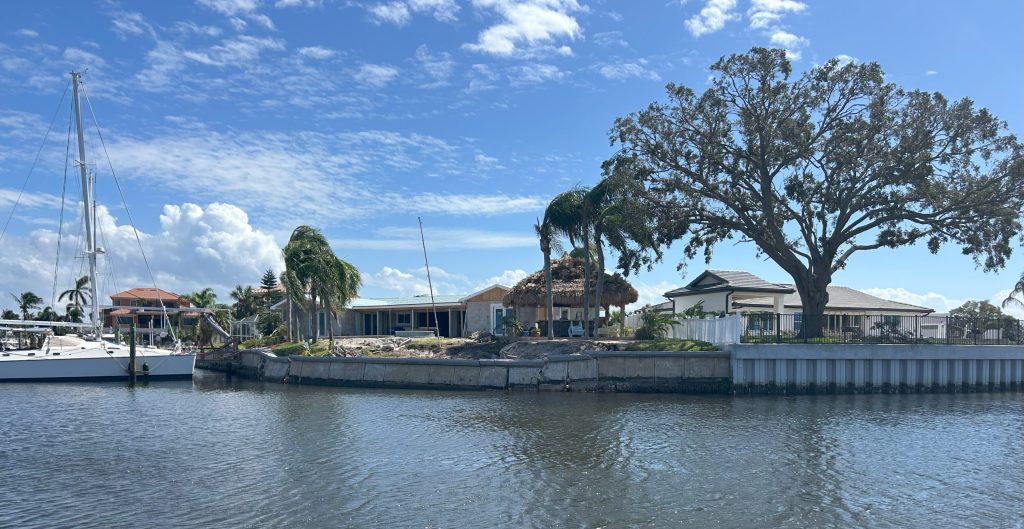
Photo 1
In 2 days, we will teach you what you need to know to successfully tackle soil improvement projects!
Seawall deterioration generally manifests through two major categories:
When structural degradation occurs – particularly of concrete, steel, or timber – the best recourse is often full or partial replacement. However, when instability stems from soil loss and erosion, targeted remediation using polyurethane foam can significantly extend the structure’s lifespan.
Polyurethane foam injection provides a non-invasive, cost-effective solution for restoring soil stability and mitigating ongoing erosion behind seawalls. Injected in liquid form, the material seeks out and fills voids, permeates loose granular soils, and expands into foam to fill voids or form a dense, interlocked soil-foam matrix. This reaction creates a durable support system that:
Unaddressed soil loss behind a seawall can lead to surface settlement, threatening the integrity of nearby infrastructure. More critically, erosion at the toe (base) of the wall significantly increases the risk of rotational failure – a failure mode that is often difficult to detect without targeted subsurface investigation.
An important consideration during foam injection is the presence of weep holes – drainage outlets built into many seawall systems to relieve hydrostatic pressure. Care must be taken to avoid unintentionally sealing these drainage channels. If foam must be injected near a weep hole, plan to re-establish drainage by drilling through and beyond the treated area to install a new weep path, ensuring continued hydrostatic pressure relief and long-term system performance.
Identifying soil instability early is key to successful remediation. Two practical methods are commonly used to identify the soil depths to target:
DCP results before and after polyurethane injection provide tangible evidence of effectiveness, typically showing increased blow counts (a proxy for soil strength) in treated zones. Figure 1 demonstrates the marked improvement in soil resistance post-injection (red line), validating both the reach and performance of the treatment.
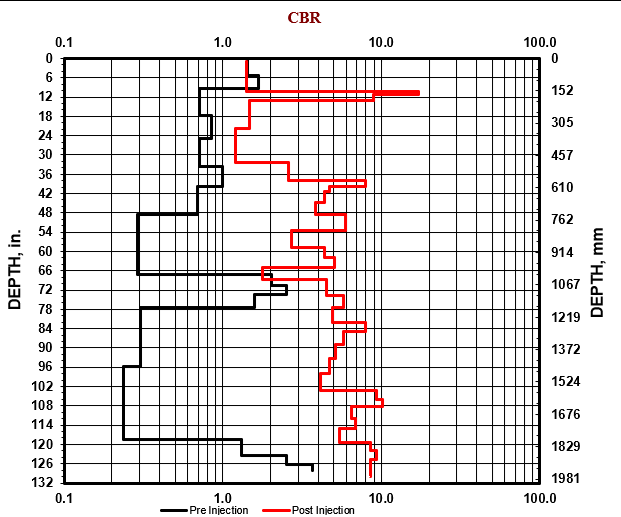
Figure 1
Polyurethane foam is unique in its ability to adapt to diverse subsurface conditions. Key features of the injection process include:
By leveraging these unique properties, polyurethane foam not only halts ongoing erosion but also reinforces the ground matrix, thereby dramatically extending the seawall’s functional lifespan without the need for full structural replacement. Which HMI foam would be the best solution for your problem?
Ideal for deep void filling, rapid load-bearing stabilization, and filling large voids when high strength and fast reactions are desired.
Advantages:
Limitations:
Best suited for sealing concealed cracks and gaps, use near sensitive structures, permeation grouting in granular soils, and precise applications where control or a surgical approach is prioritized.
Advantages:
Limitations:
As described above, choosing between single- and two-component foam depends on; proximity to and sensitivity of structural elements, size and shape of the voids, presence of groundwater or inflow, required mechanical strength of the repair. In some applications, a hybrid approach may be appropriate. For instance, single-component foam can be used initially to seal fine cracks and follow water migration paths due to its moisture-activated nature and low expansion pressure. Once these erosion pathways are sealed, dual-component foam can then be applied to fill larger voids and achieve deeper soil compaction in more stable, accessible zones – combining the strengths of both systems for a comprehensive and resilient repair strategy.
Contact HMI to learn more about the products and equipment used for ground improvement. Offer property owners engineered and cost-effective solutions.
Our engineering team can assist with product selection, integration, and technical troubleshooting.
Submit a request through our Engineering Support Form to connect with our HMI Engineering Team.