Every public works director knows the feeling of walking a city block and counting the hazards. The causes may be aging infrastructure, freeze-thaw cycles and a budget that hasn’t grown in years. Suddenly, you’re stuck managing a crisis with a checkbook that can’t keep up.
The stakes are high. Vertical displacements exceeding 1/4 inch constitute a compliance violation. Meanwhile, personal injury claims against municipalities are a serious concern, with trip-and-fall incidents posing significant financial consequences. The traditional response is to rip out the slab, haul away tons of concrete, pour new material, wait days for it to cure and repeat the cycle next season when the ground shifts again. It’s expensive, slow and unsustainable when deterioration outpaces your replacement budget.
There is a better way. Methods for city trip hazard removal, like mudjacking and polyurethane lifting, let you stretch maintenance dollars while eliminating hazards in hours rather than days. Plus, you likely already own most of the supporting equipment needed to bring this capability in-house.
The Real Cost of Replacement vs. Repair
While prices fluctuate, structural concrete averages about $645 per cubic yard. A figure that doesn’t include demolition, hauling, labor or the administration involved in managing a multi-day project. When comparing the cost of sidewalk replacement vs. repair, the gap is staggering.
Full replacement means dealing with significant operational complexity:
- Heavy equipment mobilization: Excavators, concrete saws, jackhammers and haul trucks need to coordinate arrival times and work schedules. This coordination alone adds administrative burden and increases the risk of delays when one piece of equipment or operator isn’t available.
- Multi-day timeline: Traditional concrete needs three to seven days of curing time before the sidewalk can safely reopen to foot traffic. Meanwhile, your city maintains barricades, monitors the site and fields complaints from homeowners and businesses.
- Extensive traffic control: Your crew must install and monitor barricades, post signage, manage pedestrian detours and ensure vehicle traffic flows safely around the work zone. This labor-intensive process continues for the project duration.
- Active liability exposure: The trip hazard remains cordoned off but still represents a nuisance and liability risk until the new concrete fully cures and achieves safe load-bearing capacity.
Now, consider the math. When you choose full replacement, you aren’t just paying that premium for new material. You’re also paying for hours of demolition, heavy equipment rentals, hauling fees and landfill disposal.
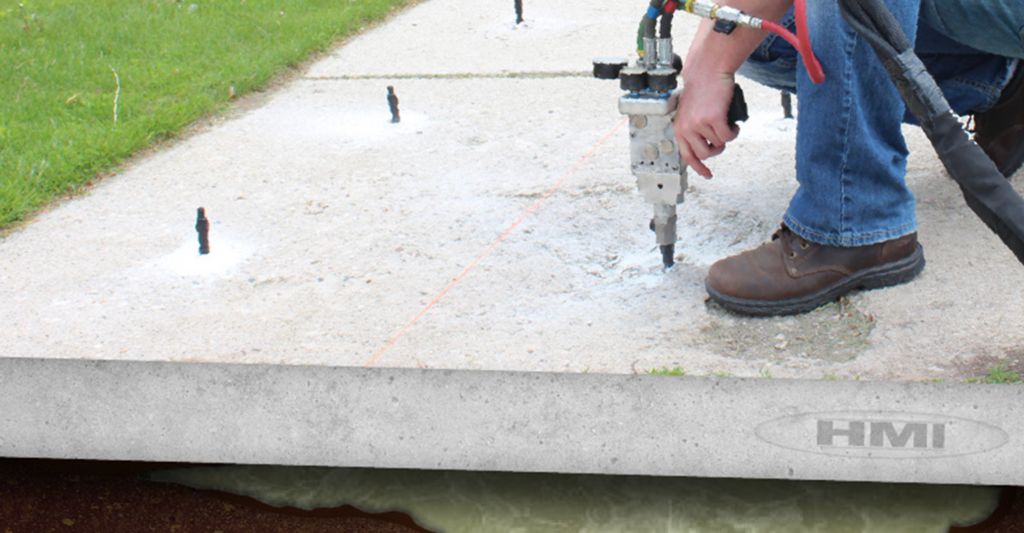
Raising concrete typically saves 30% to 50% compared to replacement costs. Municipal sidewalk repair equipment designed for lifting gets your crew in and out in hours. A two-to-three-person team drills small injection ports, pumps material underneath to raise and stabilize the slab, patches the holes and moves to the next site. The concrete is ready for foot traffic within a few hours and for vehicles within 24 hours, depending on the material you choose.
Leveraging Your Current Equipment for Sidewalk Repairs
Many cities that bring public works concrete lifting in-house find they already have most of the supporting infrastructure:
- Existing utility trucks and trailers can tow in-house municipal mudjacking equipment to jobsites.
- Drills, jackhammers and rotary hammers in your tool inventory create the injection ports required for material delivery.
- Traffic control signs, barricades and personal protective equipment you use daily transfer to concrete lifting operations.
The missing piece is the polyurethane or mudjacking system, which turns out to be a relatively modest investment compared to the ongoing cost of hiring contractors.
Control Your Schedule and Costs
When public works directors are forced to rely on outside firms for city trip hazard removal, they compete for their availability during peak season, negotiate rates on the firms’ terms and lose control over scheduling. Emergency repairs can get expensive fast when contractors are called at the last minute.
Insourcing gives you schedule control and cost predictability. Your crew responds to hazards on your timeline. You can prioritize high-traffic areas, coordinate repairs around community events and knock out smaller jobs that contractors won’t even bid because the mobilization cost isn’t worth their time. And your operators are already on payroll and familiar with your city’s infrastructure quirks.
Train Your Existing Crew in Two Days
The training barrier is lower than you think. A comprehensive two-day beginner seminar covers everything your crew needs:
- Hands-on equipment operation: Instructors guide your crew through real concrete-lifting scenarios to build confidence with proportioning equipment, injection guns and material-mixing systems. This practical experience means operators return to your city ready to tackle actual repairs, not just theory.
- Estimating techniques: Your team learns to accurately assess void sizes, calculate material requirements and predict project timelines. These skills prevent costly over-ordering of materials and help you quote jobs confidently when planning seasonal city sidewalk leveling programs.
- Business fundamentals: Training covers pricing strategies, scheduling optimization and program management principles that help you run an efficient in-house operation. You’ll understand how to track costs, measure productivity and demonstrate ROI to city administrators.
- Troubleshooting skills: Training includes common challenge scenarios, like difficult soil conditions, weather complications and equipment adjustments, so your operators can handle field problems independently. This problem-solving foundation reduces downtime and keeps repairs moving forward.
This way, you are upskilling people who already understand your city’s needs and work ethic to build your own municipal concrete raising program.
The training investment pays dividends beyond the technical skills. Operators learn to assess job conditions, estimate material needs, and troubleshoot common challenges in real time. Over the course of a season, that accumulated experience turns your crew into the local experts contractors used to be.
Which Repair Material and Method Is Right for Your City?
Once you’ve decided to bring repair capabilities in-house, the next question is which material to use.
Both mudjacking and polyurethane foam have earned their place in municipal concrete maintenance programs. The choice often depends on application type, budget priorities and the specific conditions you address most often.
Mudjacking
Mudjacking has been the go-to method for decades, and for good reason. The process uses a sand-cement slurry pumped under pressure to fill voids, compact soil and raise sunken concrete. It’s the budget-friendly option with low material costs.
Key advantages for municipal operations:
- Local material sourcing: Sand and cement come from suppliers your purchasing department already uses, so there are no special ordering processes, no long lead times or dependency on distant distributors. This familiarity streamlines procurement and keeps your supply chain predictable even during peak repair seasons.
- Versatile applications: Mudjacking pumps for municipalities handle everything from narrow sidewalk panels to large parking lot sections and roadway repairs. This versatility means you invest in a single system that addresses the full range of concrete-lifting challenges year-round.
- No supply chain anxiety: During the spring thaw, when trip hazards emerge across the city and repair demands spike, you can mix materials from readily available local ingredients instead of waiting on specialty shipments or dealing with distributor backorders that could delay critical safety repairs.
Polyurethane
Polyurethane foam represents the modern evolution of concrete lifting technology. The material is a two-component system that reacts and expands rapidly after injection to fill voids and raise slabs with remarkable precision.
For city sidewalk leveling managers focused on high-traffic areas or projects where downtime must be minimized, poly delivers five significant advantages.
- Injection holes are 5/8 inch, creating minimal disruption to structural integrity and leaving a clean finished appearance that matters in high-visibility downtown locations.
- Cure times are measured in hours, allowing sidewalks and pathways to return to full service almost immediately after repairs.
- The material weighs 2 to 4 pounds per cubic foot, compared to mudjacking slurry’s 100-plus pounds, so you aren’t adding a load to already compromised soils.
- Operators can dial in exact lift amounts with precision control, making the material ideal for correcting quarter-inch ADA violations where accuracy is critical.
- Equipment portability and ease of handling mean two operators can efficiently manage most jobs without additional labor.
Material cost is higher than mudjacking, but that premium buys speed, precision and reduced labor. Cities often deploy poly systems for downtown sidewalks, ADA ramp corrections and other visible applications where appearance and rapid turnaround matter most. They’ll use mudjacking for back-lot repairs and less critical applications. Many municipalities run both systems to match the method to the job.
Concrete Repair Equipment Built for Municipal Workloads
The equipment that makes in-house repair possible doesn’t need to be complicated, but it needs to be reliable.
The best hydraulic mudjacking pumps for sale are purpose-built for the kind of daily workload public works departments generate. These systems are designed around simplicity, durability and the understanding that your operators need to be productive from day one without a steep learning curve.
Hydraulic Mudjacking Systems
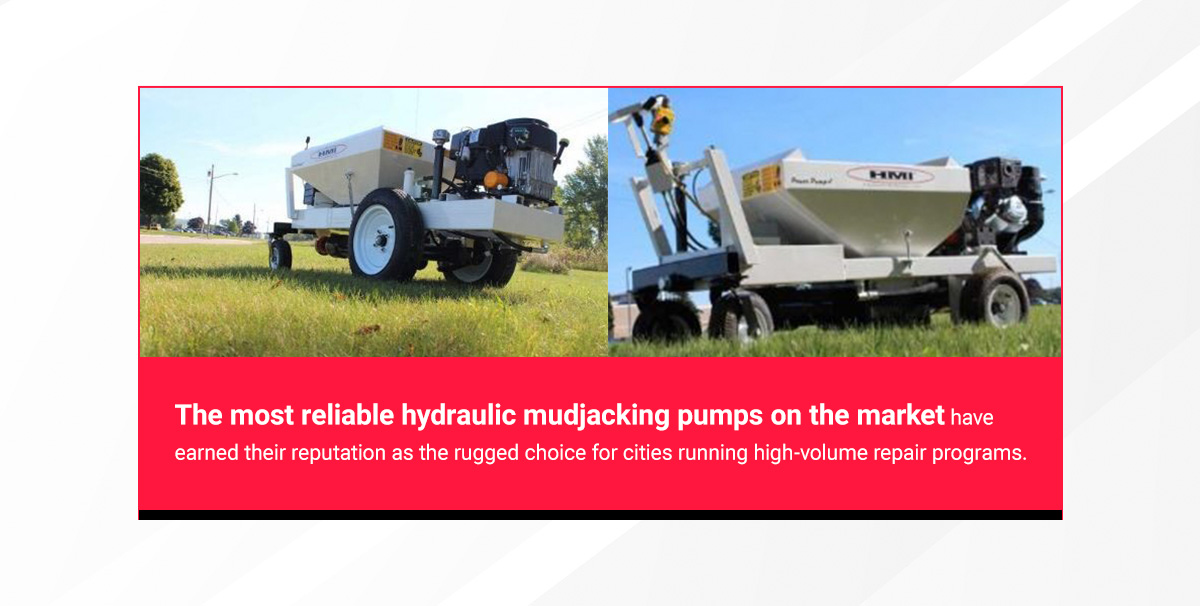
The most reliable hydraulic mudjacking pumps on the market have earned their reputation as the rugged choice for cities running high-volume repair programs. The systems handle the sand-cement slurries that make mudjacking cost-effective, and the hydraulic drive delivers consistent pressure across varied job conditions.
Look for systems built to withstand the environmental conditions municipal equipment is exposed to. Industrial-grade components and straightforward designs minimize downtime and keep your crew productive throughout the repair season.
Polyurethane Foam Systems
For departments choosing the polyurethane route, advanced polyurethane concrete raising systems bring the same durability ethos to foam application:
- Precise proportioning maintains the 1:1 ratio essential for quality foam expansion and consistent lifting performance.
- Heated hoses keep material flowing even in cold weather, when other systems might struggle with viscosity.
- Patented air-purge gun technology clears injection ports instantly to allow multiple injections per hole without stopping to clean clogged equipment.
- Rugged construction handles the dust, mud, temperature swings and occasional rough handling that comes with daily field work.
The Air-Purge Advantage
The air-purge feature deserves special mention because it fundamentally changes how operators work.
Traditional injection guns clog, forcing crews to drill new holes or stop work to clean equipment. The best systems blast air through the tip to clear material and keep the injection port open when your not pumping. This means you can make multiple injections through the same port and go back to fine-tune lifts after seeing how the slab responds. For municipal crews learning the craft, that forgiveness factor significantly accelerates the learning curve.
Modern polyurethane concrete sidewalk repair equipment, designed specifically for municipal applications, translates directly into field success. When your crew runs into challenging jobs or needs troubleshooting guidance, quality equipment suppliers provide the ongoing technical support and training resources that transform equipment purchases into long-term program success.
Why Trust HMI?
We’ve been in business since 1974, when our founder engineered the concrete raising industry’s first all-hydraulic pumping system. Over five decades, we’ve led through continuous innovations — pioneering self-powered equipment, wireless remote operation and the patented air-purge gun technology that changed how operators work in the field.
We’re a family-owned manufacturer that mixes polyurethane foam daily. Our environmentally conscious poly is made from over 40% recycled materials. This is the greenest polyurethane foam on the market, developed by our in-house chemist specifically for municipal applications.
We don’t sell equipment and walk away. We build long-term partnerships through hands-on training, ongoing technical support and genuine commitment to your program’s success. With HMI in your corner, your crew fixes what used to take days in just hours, getting sidewalks back to safe, compliant condition before citizens even notice the closure. You’re not waiting on contractor availability during peak repair season or negotiating rates for every emergency fix. Instead, you’re maximizing the ROI of equipment and personnel already on staff.
We help you build a truly effective municipal concrete maintenance program with purpose-built systems engineered for demanding municipal workloads. Our training programs feature instructors with decades of field experience. They lead hands-on sessions that turn your crew into confident operators using proven concrete trip-hazard repair methods that make municipal work faster and more efficient.
Build Your In-House Repair Program With HMI
The partnership doesn’t end after training. Expert technical support remains available when challenging jobs arise, so you’re calling experienced professionals who’ve guided hundreds of cities through the same scenarios you’re facing. From equipment selection to operator training to ongoing troubleshooting, HMI is with you every step.
Let’s talk about building your in-house repair capability with equipment, training and support. Contact our team to discuss system options, training schedules and how we can help your city take control of concrete repair.