
Cookies & Your Privacy
This website uses cookies to ensure you get the best experience on our website. More Information >
Home » Technical Articles » Stabilizing Roadway Subgrades and Bridge Approaches Using Deep Foamjection®
Will Sublette, P.E.
Geotechnical Engineer
Across the U.S., aging transportation infrastructure faces increasing pressure not only from traffic loading and climatic events but also from the subsurface environment. Differential settlement, voids, and unstable soils threaten the integrity of pavements and bridge abutments, often long before surface deterioration is visible. This article presents a geotechnically sound approach to remediating these challenges using Deep Foamjection®, a polyurethane-based ground improvement method developed by HMI. The method is evaluated in the context of subsurface failure mechanisms and compared with traditional remediation techniques.
Roadways and bridge abutments are inherently sensitive to the behavior of subsurface soils. Common failure indicators—surface cracking, rutting, and slab displacement—often trace back to issues beneath the surface such as:
In many DOT-maintained systems, maintenance crews resort to surface grinding, asphalt patching, or sub-base replacement—repairs that are often short-lived due to their failure to address the underlying geotechnical problems.
This site is protected by reCAPTCHA and the
Google Privacy Policy and Terms of Services apply.
In 2 days, we will teach you what you need to know to successfully tackle soil improvement projects!
HMI’s Deep Foamjection® method involves the controlled injection of high-density polyurethane foam into subsurface soils. The process leverages the expansive properties of structural polyurethane to compact, stabilize, and lift deficient soils. The operation includes:
Notably, the polyurethane foam used by HMI cures rapidly (often within 15 minutes), is hydrophobic, and has compressive strengths ranging from 50 psi to over 100 psi depending on formulation and confinement conditions.
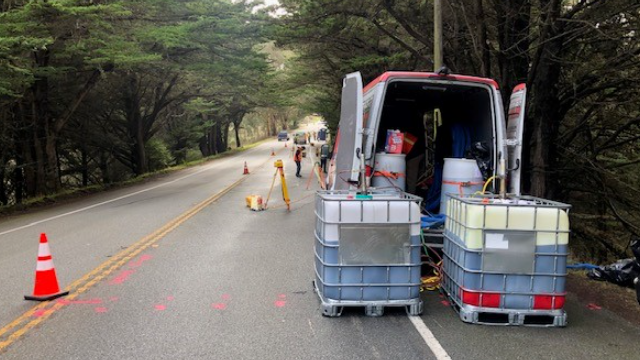
The Deep Foamjection® method addresses critical failure mechanisms through soil-structure interaction improvements, rather than surface-level treatments. Key geotechnical benefits include:
Verification is conducted using tools such as DCP, plate load testing, and ground-penetrating radar. These tests can establish pre- and post-treatment stiffness profiles and verify that the foam reached design depths and achieved sufficient soil densification.
From a construction logistics perspective, Deep Foamjection® can be performed with minimal surface disturbance. Traffic lanes often remain open during application—a major benefit for urban arterials and bridge decks.
Common applications of Deep Foamjection® in transportation infrastructure include:
Deep Foamjection® offers a technically robust, minimally invasive method for addressing subsurface geotechnical deficiencies in transportation infrastructure. By combining engineered polyurethane chemistry with modern installation and verification methods, this technique offers DOTs and contractors a reliable alternative to legacy methods. It provides both immediate structural benefits and long-term durability, especially in environments where soil conditions are unpredictable or access is constrained.
For engineers and transportation agencies seeking to mitigate subsurface risks while maintaining operational continuity, Deep Foamjection® presents a practical, tested solution that deserves strong consideration.
Our engineering team can assist with product selection, integration, and technical troubleshooting.
Submit a request through our Engineering Support Form to connect with our HMI Engineering Team.
4466 Custer Street
Manitowoc, WI 54220