
Cookies & Your Privacy
This website uses cookies to ensure you get the best experience on our website. More Information >
Home » Technical Articles » Field Applications of Structural Polyurethane in Soil–Structure Interaction Systems
As infrastructure continues to age and site conditions become more constrained, engineers are evaluating alternatives to traditional cement-based grouts for soil improvement and structural support applications. One grout material being utilized across many applications is high-density polyurethane foam. Under appropriate loading and environmental conditions, the unique material properties of polyurethane foam provides an advantage over cementitious grouts in certain scenarios.
Concrete is well known for its high compressive strength but comparatively low tensile capacity, with tensile strength typically on the order of 8–12% of its compressive strength. High-density structural polyurethane foam, by comparison, develops both compressive and tensile strength, with tensile capacity commonly exceeding 50% of its compressive strength depending on density and formulation. While the absolute strength values differ from concrete, the strength ratio and ductile behavior can be advantageous in certain soil-structure interaction scenarios.
Polyurethane foam is injected as a liquid and reacts at a controlled rate, expanding to fill regular and irregular. This expansion also allows the material to establish contact with surrounding soils and structural elements without relying solely on gravity flow or high pumping pressures. Cure times are fast for many formulations, the material reaches approximately 90% of its compressive strength within 30 minutes. These characteristics can reduce construction durations and service interruptions compared to conventional grouting operations.
These properties have been applied in pile and utility pole stabilization, as well as in soil nail and anchor systems.
This site is protected by reCAPTCHA and the
Google Privacy Policy and Terms of Services apply.
In 2 days, we will teach you what you need to know to successfully tackle soil improvement projects!
Leaning or underperforming utility poles are often repaired by resetting or replacing the pole, which can require extended service outages. In some cases, poles are re-plumbed and the annular space is backfilled with sand or conventional grout. These approaches may restore alignment but do not always address the underlying soil support conditions.
Polyurethane foam has been used as an alternative infill material in these scenarios. When injected into the annulus between the pole and surrounding soil, the expanding material fills irregular voids and establishes continuous contact. Additional injections into adjacent soils can increase local stiffness and confinement, improving lateral resistance.
Compared to loose sand backfill, high-density polyurethane foam provides greater compressive and tensile strength and a wider strain tolerance range under cyclic loading. Its closed-cell structure resists water infiltration, which help limit moisture-related degradation or freeze–thaw effects at the soil–pole interface.
When properly designed, the result is not only a re-aligned pole but improved soil conditions relative to the pre-repair state, typically achieved with minimal service disruption.
High-density polyurethane foam has been used to rehabilitate driven piles that did not initially meet performance criteria. The mechanism typically involves improving load transfer by filling voids at the soil–pile interface, increasing confinement, and locally densifying surrounding soils. The result can be an increase in composite stiffness of the soil–pile system.
On a large solar project with variable and marshy subsurface conditions, several driven steel test piles did not satisfy axial (compression and tension) or lateral load requirements. With piles already installed, options for remediation were limited. Targeted polyurethane injection was evaluated as an in-situ stabilization method.
Test sections were established in the weakest soil areas. Due to the marsh environment and groundwater sensitivity, a hydro-insensitive formulation (HF402) was selected to promote full reaction in wet conditions and limit environmental interaction during curing. Comparative load testing was performed on treated and untreated piles based on a defined injection program.
Average improvements observed during testing were:
Additional capacity gains were considered achievable with expanded injection patterns; however, the objective was to meet performance criteria with the most efficient material usage. The approach allowed the project to proceed without pile removal or major schedule impacts.
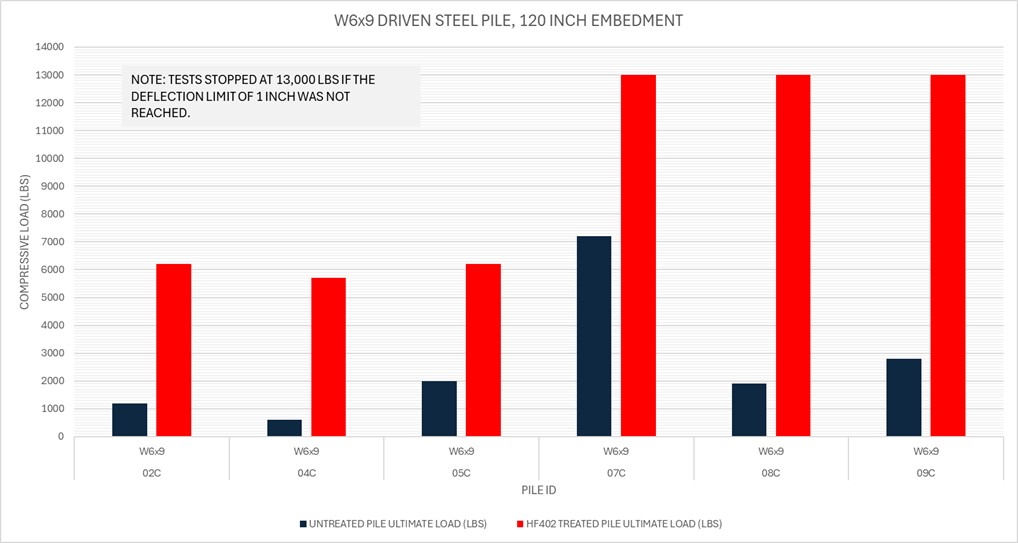
Table 1: Compressive Load Pile Test
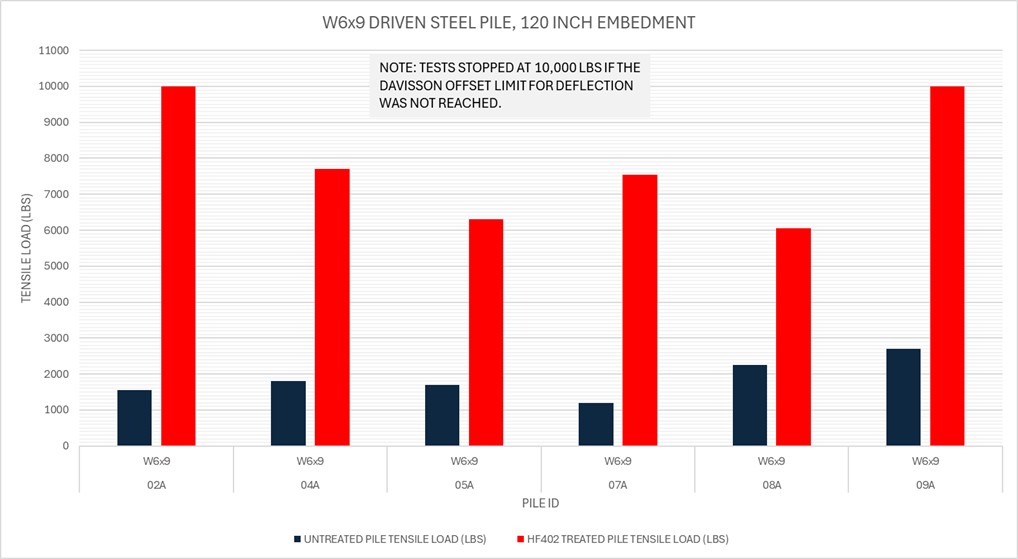
Table 2: Tensile Load Pile Test
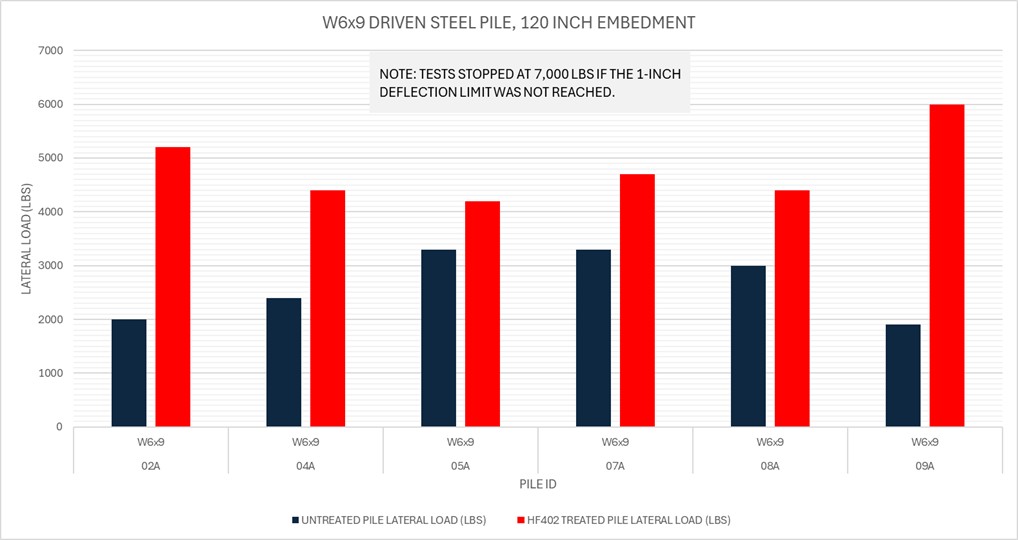
Table 3: Lateral Load Pile Test
Cementitious grouts have long been the standard material for soil nail systems due to their reliable bond strength, compressive strength, and stiffness. These properties allow soil nails and other ground support elements to achieve high load capacities with relatively low deflection and strain. However, the timing of load application is governed by strength development. In most applications, structural loading and proof testing are not performed until a minimum of approximately seven days after installation to allow sufficient curing. Because soil nail walls are constructed in staged excavations, advancement to subsequent lifts also requires additional time for the shotcrete facing to gain adequate strength prior to further excavation.
On an excavation support project with a compressed schedule, this curing timeline of cement grout and shotcrete became a critical constraint. Based on prior successful applications of polyurethane for in-situ pile stabilization in tension, polyurethane systems were evaluated as an alternative grout and facing material. RR501 polyurethane foam was considered for soil nail grouting, and RR601 polyurethane foam for the facing element. The high early strength and rapid cure characteristics of these materials offered the potential to safely accelerate the construction sequence.
To establish preliminary design parameters, a series of pull tests were conducted on trial soil nails installed in comparable subsurface conditions. Both tests exceeded the required design load of 2,600 lb. The elastic yielding loads were measured at 8,400 lb and 11,500 lb, respectively. The corresponding calculated elastic bond strengths were 20.2 psi and 27.2 psi. For design purposes, a factor of safety was applied to the lower measured bond value. In one test, loading was continued beyond the elastic range until failure occurred in the 5/8-inch A36 all-thread steel bar, confirming that bond capacity exceeded the tensile capacity of the steel element.
The test results provided sufficient confidence to proceed with the design approach. The excavation, measuring approximately 8.5 ft deep and 12 ft by 12 ft in plan, was completed in multiple stages. Soil nails were grouted using RR501 polyurethane, and the facing was free-sprayed with RR601 polyurethane at each lift. The excavation was fully stabilized in five days.
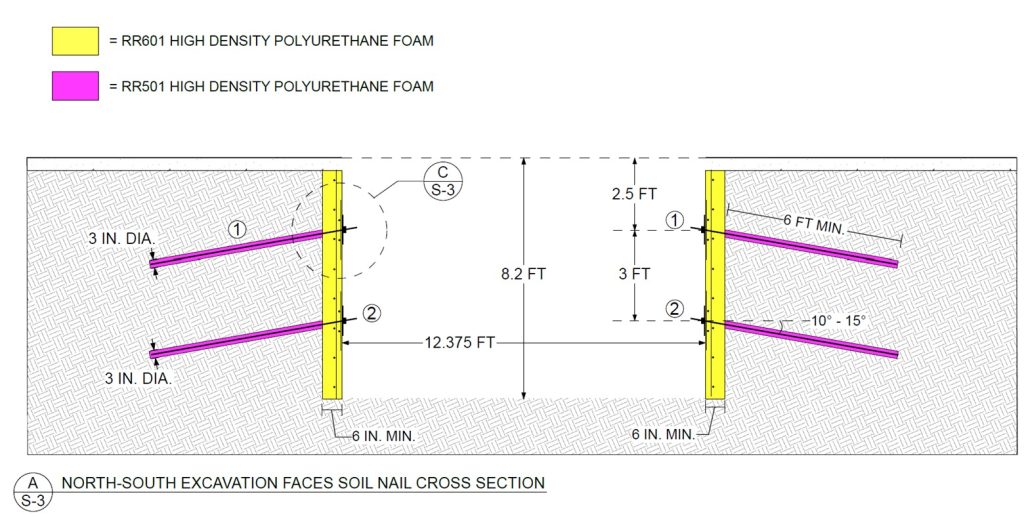
Figure 1: Soil Nail Cross Section
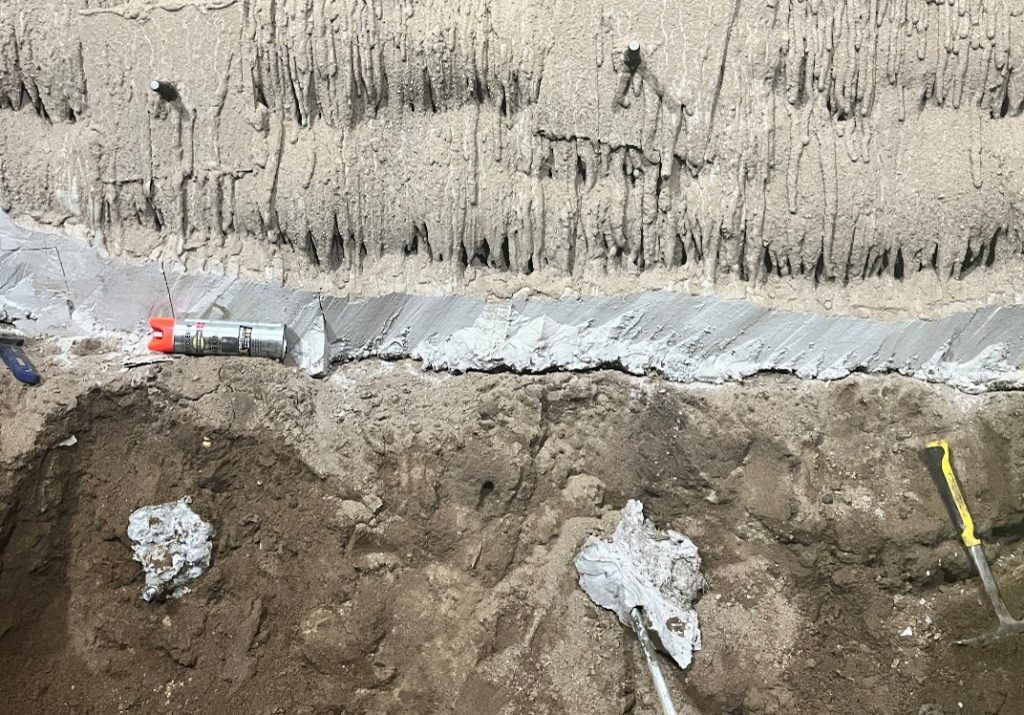
Figure 2: Polyurethane Grouted Soil Nail and Polyurethane Facing
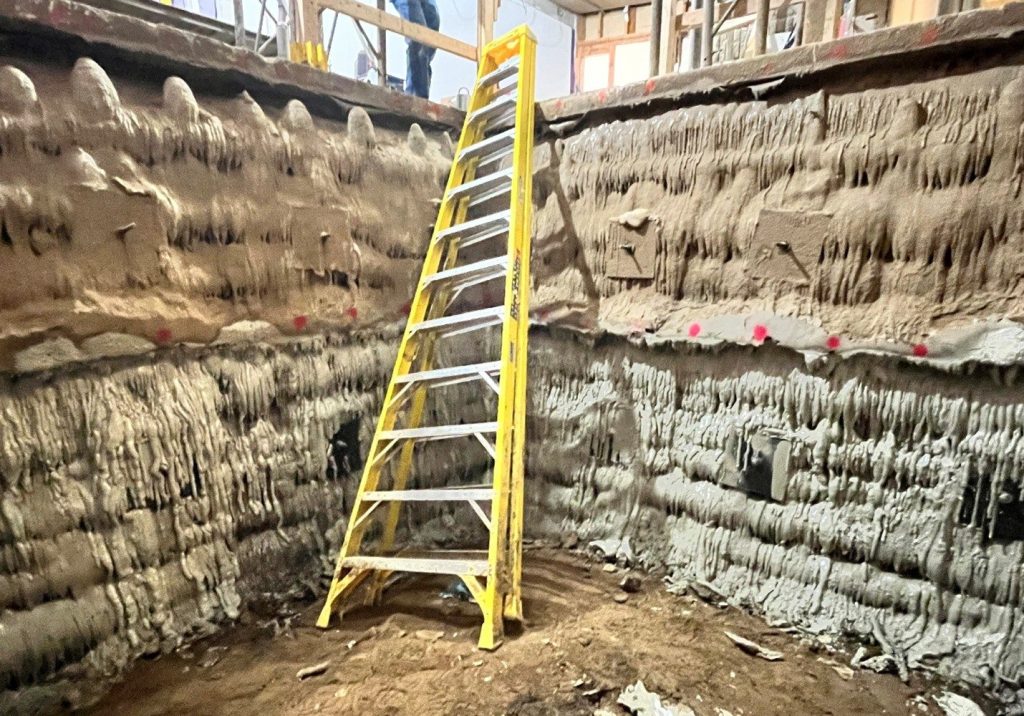
Figure 3: Polyurethane Soil Nail System
In addition to schedule acceleration, the material properties of polyurethane contributed to construction safety. Unlike brittle cementitious materials, polyurethane foam exhibits ductile behavior with meaningful residual strength even after yielding. This characteristic reduces the likelihood of sudden, brittle failure and provides a more gradual load redistribution response under overstress conditions.
Polyurethane foam is not a universal substitute for cement grout. Its performance must be evaluated for sustained loading, creep behavior, temperature exposure, and long-term durability within the specific geotechnical and structural context. Load magnitude, deformation tolerances, and environmental conditions remain governing design factors.
However, when applied within appropriate engineering limits, high-density structural polyurethane can serve as a complementary stabilization tool. As project timelines tighten and access constraints increase, materials that offer controlled expansion, rapid strength gain, and adaptable installation methods are becoming more integrated into geotechnical rehabilitation practice.
At HMI, your operation’s success is our highest priority. Our knowledgeable and experienced team is ready to answer your questions and provide comprehensive support for each project you undertake.
We offer everything from on-site assistance and in-depth equipment training to innovative marketing tools and sales leads. Our goal is to provide you with the expertise and resources necessary to operate a profitable concrete-raising business.
Whether you’re launching a new business or considering expanding your current services, HMI’s experienced staff is committed to helping you build a reliable and reputable operation. We go above and beyond similar companies by understanding your operational needs and providing practical and effective solutions tailored to your requirements.
4466 Custer Street
Manitowoc, WI 54220