
Strategies for Seawall Stabilization: Deep Foamjection® and Comparative Approaches

Will Sublette, P.E.

Geotechnical Engineer

Understanding the Challenge

Seawalls are vital in safeguarding shore infrastructure against the constant forces of wave action, tidal movement, and storm surges. Despite their critical role, these structures are often compromised by soil instability on the landward side, a commonly overlooked threat. The primary failure mechanism in seawalls typically originates not from water pressure on the seaward face, but from internal erosion and soil migration behind or beneath the structure. These soil voids develop as soil particles erode through joints, cracks, or foundation undermining, eventually threatening the entire wall’s integrity.
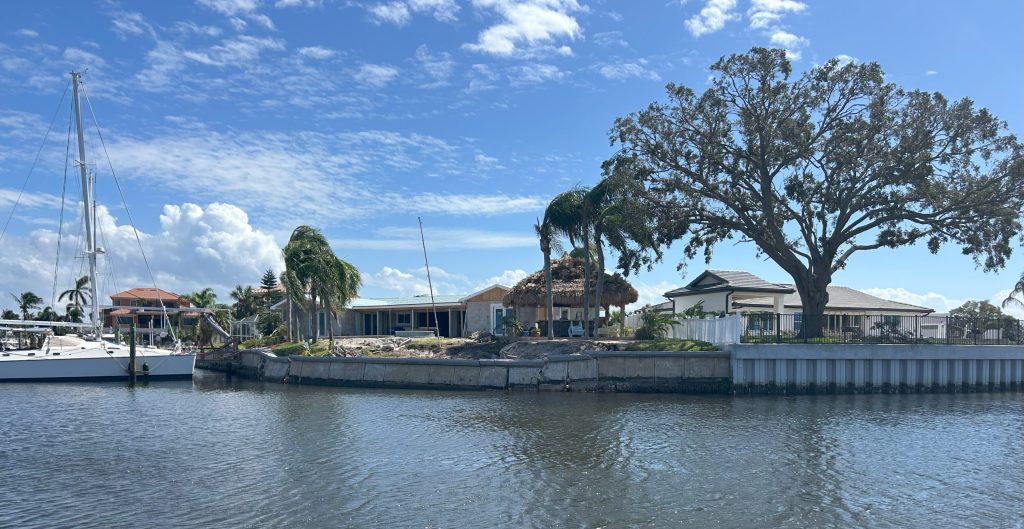
Photo 1

Request Soil Improvement Information

This site is protected by reCAPTCHA and the
Google Privacy Policy and Terms of Services apply.

Soil Improvement Seminar

  • April 16-17, 2026  Manitowoc, WI

In 2 days, we will teach you what you need to know to successfully tackle soil improvement projects!

Common Seawall Failure Modes

Seawall deterioration generally manifests through two major categories:

  • Material Degradation: Corrosion of steel reinforcements Concrete spalling or cracking Timber decay or biological degradation
  • Stability Failures: Overturning due to excess loading at the top of wall or anchor failure Lateral sliding from reduced friction between elements or excessive lateral loading
  • Undermining at the wall base, initially starting with settlement and potentially leading to rotational failure at the bottom of the wall, as shown in Photo 1.

When structural degradation occurs – particularly of concrete, steel, or timber – the best recourse is often full or partial replacement. However, when instability stems from soil loss and erosion, targeted remediation using polyurethane foam can significantly extend the structure’s lifespan.

The Role of Polyurethane Foam in Seawall Rehabilitation

Polyurethane foam injection provides a non-invasive, cost-effective solution for restoring soil stability and mitigating ongoing erosion behind seawalls. Injected in liquid form, the material seeks out and fills voids, permeates loose granular soils, and expands into foam to fill voids or form a dense, interlocked soil-foam matrix. This reaction creates a durable support system that:

  • Seals cracks and voids within the seawall structure
  • Prevents continued soil migration and internal erosion
  • Improves overall stability and performance of the seawall structure

Unaddressed soil loss behind a seawall can lead to surface settlement, threatening the integrity of nearby infrastructure. More critically, erosion at the toe (base) of the wall significantly increases the risk of rotational failure – a failure mode that is often difficult to detect without targeted subsurface investigation.

An important consideration during foam injection is the presence of weep holes – drainage outlets built into many seawall systems to relieve hydrostatic pressure. Care must be taken to avoid unintentionally sealing these drainage channels. If foam must be injected near a weep hole, plan to re-establish drainage by drilling through and beyond the treated area to install a new weep path, ensuring continued hydrostatic pressure relief and long-term system performance.

Evaluating Seawall Instability: Detection Methods

Identifying soil instability early is key to successful remediation. Two practical methods are commonly used to identify the soil depths to target:

  • Push-Probe Testing: A quick field method to manually feel the resistance in soil at varying depths, which can indicate voids or soft zones.
  • Dynamic Cone Penetrometer (DCP) Testing: A more quantitative method that measures soil resistance with depth. Performing DCP tests to depths just below the bottom of the seawall is critical in identifying undermining at the toe of the wall and potential global instability.

DCP results before and after polyurethane injection provide tangible evidence of effectiveness, typically showing increased blow counts (a proxy for soil strength) in treated zones. Figure 1 demonstrates the marked improvement in soil resistance post-injection (red line), validating both the reach and performance of the treatment.
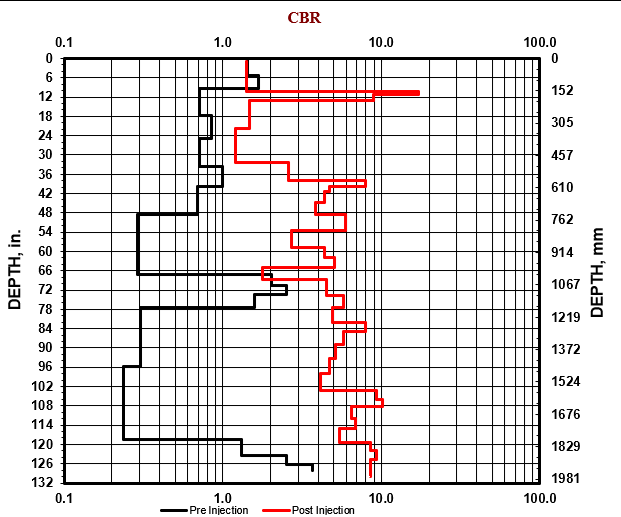
Figure 1

Mechanics of Polyurethane Injection: How It Works

Polyurethane foam is unique in its ability to adapt to diverse subsurface conditions. Key features of the injection process include:

  • Low Viscosity Penetration: Allows the liquid resin to infiltrate small voids, cracks, and permeable soils before expansion.
  • Controlled Expansion Rates: Reaction times can be tailored from seconds to minutes, dictating how far the material travels before expanding and setting.
  • Rapid Strength Gain: Full structural strength is typically achieved within 30 minutes post-injection.
  • Varied Densities and Strengths: Different formulations offer flexibility depending on whether the goal is stabilization, sealing, or load-bearing improvement.
  • Environmental Compatibility: HMI’s polyurethane foams are designed to be chemically inert once cured, eliminating risk of leaching or contamination to the surrounding environment.

By leveraging these unique properties, polyurethane foam not only halts ongoing erosion but also reinforces the ground matrix, thereby dramatically extending the seawall’s functional lifespan without the need for full structural replacement. Which HMI foam would be the best solution for your problem?

Two-Component vs. Single-Component Polyurethane Foam

High Density Two-Component Polyurethane Foam

Ideal for deep void filling, rapid load-bearing stabilization, and filling large voids when high strength and fast reactions are desired.

Advantages:

  • Higher Strength and Density: Offers robust, long-term structural reinforcement, especially effective in scenarios involving substantial voids.
  • Greater Expansion: Its highly expansive nature allows it to fill large voids with less material, making it more volume-efficient for extensive stabilization work.

Limitations:

  • Potentially Excessive Expansion Pressure: The aggressive expansion of dual-component foam can exert high pressure, posing a risk of shifting or damaging sensitive or aging seawall structures if an area is over-injected with material.
  • Premature Reaction: Due to its consistent and rapid reaction profile, the foam may begin expanding before fully reaching intended gaps or voids, potentially blocking flow paths and reducing treatment effectiveness in critical areas.
  • Specialized Equipment and Reach Constraints: Requires a dual-component proportioner system, which represents a higher equipment investment. Additionally, the maximum hose length for most proportioners is typically limited to around 310 feet, which can restrict access to remote or difficult-to-reach injection zones.

Single-Component Polyurethane Foam

Best suited for sealing concealed cracks and gaps, use near sensitive structures, permeation grouting in granular soils, and precise applications where control or a surgical approach is prioritized.

Advantages:

  • Water-Activated Reaction: Reacts only upon contact with moisture, allowing the foam to instinctively follow and seal active erosion pathways and voids without premature expansion.
  • Customizable Reaction Time: The reaction time of single-component polyurethane foam can be precisely adjusted in the field using catalysts, allowing installers to tailor the foam’s behavior to site-specific conditions in real time. By extending the reaction window, the resin remains in a liquid state longer, enabling deeper soil penetration and longer travel distances before expansion. This delay allows the foam to follow the path of least resistance, effectively locating and sealing hidden cracks, voids, and erosion channels – enhancing treatment accuracy and reducing uncertainty in subsurface applications. Conversely, accelerating the reaction time is advantageous when targeting known voids, allowing rapid sealing with minimal material usage and improved injection control.
  • Low Expansion Pressure: Generates minimal expansion force during curing, making it ideal for applications near delicate or structurally sensitive seawall components where excessive pressure could cause damage.
  • Uniform Soil Permeation: When injected at low pressure into permeable, granular soils, single-component foams can achieve greater coverage and consistency. This results in a well-bonded soil-foam matrix that improves overall ground stability and erosion resistance.
  • Affordable Compact and Mobile Equipment: Smaller, more portable injection systems enable installers to access confined or hard-to-reach areas with ease, making them ideal for projects in locations with limited site access or challenging terrain.

Limitations:

  • Reduced Load-Bearing Strength: Although resilient, single-component foam lacks the structural strength of dual-component foam in its pure, cured state, making it less effective for stabilizing large voids. However, when injected into granular soils, it enhances strength by locking soil particles together and forming a cohesive, reinforced mass.
  • Moisture Dependency: The foam’s reaction relies on the presence of sufficient water in the surrounding environment. In dry soils, especially those with low natural moisture content, expansion yield and effectiveness may be significantly diminished. It may be necessary to saturate the soils to have the necessary moisture available to active.   Required moisture level also varies depending on the foam’s viscosity and formulation.

Conclusion

As described above, choosing between single- and two-component foam depends on; proximity to and sensitivity of structural elements, size and shape of the voids, presence of groundwater or inflow, required mechanical strength of the repair. In some applications, a hybrid approach may be appropriate. For instance, single-component foam can be used initially to seal fine cracks and follow water migration paths due to its moisture-activated nature and low expansion pressure. Once these erosion pathways are sealed, dual-component foam can then be applied to fill larger voids and achieve deeper soil compaction in more stable, accessible zones – combining the strengths of both systems for a comprehensive and resilient repair strategy.

Contact HMI to learn more about the products and equipment used for ground improvement.  Offer property owners engineered and cost-effective solutions.

Need help with your application?

Our engineering team can assist with product selection, integration, and technical troubleshooting.
Submit a request through our Engineering Support Form to connect with our HMI Engineering Team.

Cookies & Your Privacy

This website uses cookies to ensure you get the best experience on our website. More Information >