Understanding foam density for concrete lifting applications.
If you’ve spent any time in the concrete lifting industry, you’ve probably heard people refer to 2 lb, 3 lb, or 4 lb polyurethane foam. It’s one of the most common ways contractors describe different foam formulations.
But what do those numbers actually mean?
Many people assume they’re referring to the weight of the liquid chemicals before they’re mixed. That’s a logical assumption, but it’s not correct.
In reality, the numbers refer to the density of the cured foam after it has fully expanded and hardened. Understanding this concept is the foundation for understanding why different polyurethane foams behave differently and why contractors choose different formulations for different applications.
What Does “2 lb Foam” Mean?
The “2 lb” designation refers to the density of the cured polyurethane foam. Specifically, one cubic foot of finished foam weighs approximately two pounds.
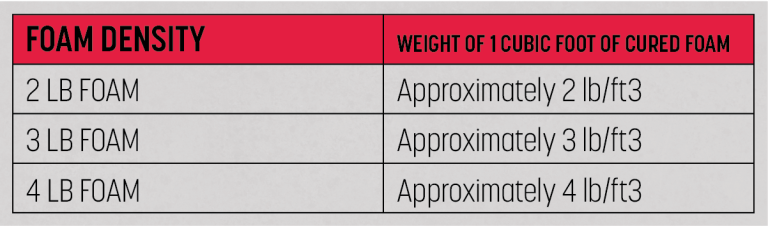
The important thing to understand is that each sample occupies the exact same amount of space: one cubic foot. The difference is how much polymer material is packed into that space.
It’s Not the Weight of the Liquid
One of the biggest misconceptions is that a 2 lb foam starts with lighter liquid chemicals than a 4 lb foam.
In reality, the liquid components for many polyurethane systems weigh very similarly before they are mixed.
The difference is not simply the starting weight or a single adjustment to the amount of blowing. Different foam systems use different formulations, and those formulations produce different expansion profiles and cured densities.
Although different foam systems use different formulations, the finished density is determined by how much solid polymer occupies a given volume after expansion.
Different formulations expand to different final volumes, resulting in different cured densities.
Simply put, the density rating describes the finished foam, not the liquid chemicals.
Think of It Like Baking
Imagine baking two cakes from similar recipes using a similar amount of batter.
One cake rises significantly higher than the other, even though both started with a similar amount of batter.
The cake that rises higher spreads a similar amount of material throughout a greater volume, making it less dense.
Polyurethane foam behaves similarly. Different formulations react and expand differently, producing different final volumes and cured densities.
Why Density Matters
Density influences several important performance characteristics of polyurethane foam.
- Higher-density foams generally contain a higher proportion of solid polymer within a given volume.
- Lower-density foams generally contain a higher proportion of gas-filled cells within that same volume.
- Higher-density foams typically provide greater compressive strength.
- Lower-density foams generally produce greater expansion and higher yield.
This relationship is one reason the concrete lifting industry uses multiple foam formulations instead of relying on a single “best” product.
Why Higher Density Usually Means Higher Strength
Imagine filling two identical boxes. One is mostly filled with packing peanuts. The other is filled with solid wood blocks.
Even though both boxes are the same size, the second box weighs more because it contains more material.
Polyurethane foam works in a similar way. Higher-density foam contains more solid polymer supporting the load within the same volume.
That additional polymer generally results in greater compressive strength and higher load-bearing capability.
Why Higher Density Usually Expands Less
There is always a balance between strength and expansion.
Lower-density foams generally produce more finished volume relative to the amount of material used.
Higher-density foams generally contain a higher proportion of solid polymer and a lower proportion of gas-filled cells, which is typically associated with lower expansion.
This is not a disadvantage. It is simply part of the chemistry.
Some projects benefit from maximum expansion. Others require greater strength. Choosing the right formulation means balancing both characteristics.
Does Higher Density Mean Better Foam?
Not necessarily.
One of the most common misconceptions in the industry is that a higher-density foam is automatically superior.
The truth is that the best foam depends on the application.
A residential sidewalk, warehouse floor, airport runway, machine foundation, and highway slab all have different performance requirements.
Some jobs prioritize yield. Others prioritize strength. Some require slower reaction speeds to maximize spread beneath the slab. Others benefit from rapid lifting.
Density is just one factor among many.
Density Does Not Tell the Whole Story
It is also important to remember that density alone does not define foam performance.
Two manufacturers may both offer a product classified as 4 lb foam, yet the products can behave very differently.
Differences in formulation, reaction profile, cell structure, expansion characteristics, and polymer chemistry all influence real-world performance.
That is why experienced contractors evaluate the entire foam system, not just the density printed on the label.
Key Takeaways
- “2 lb,” “3 lb,” and “4 lb” refer to the density of the cured foam, not the liquid chemicals before mixing.
- The liquid components may weigh very similarly, but different formulations react and expand differently, producing different final volumes and cured densities.
- Higher-density foams generally provide higher compressive strength and lower expansion.
- Lower-density foams generally provide greater expansion and yield, but lower compressive strength.
- No density is inherently better; the right choice depends on the project requirements.
Understanding density is the first step toward understanding how polyurethane foam works, but it is only one piece of the puzzle. Expansion, reaction speed, spread, compressive strength, soil conditions, and application goals all contribute to real-world performance.
Check out our next blog in this series: Blog #2 – Why are there different polyurethane foam densities?