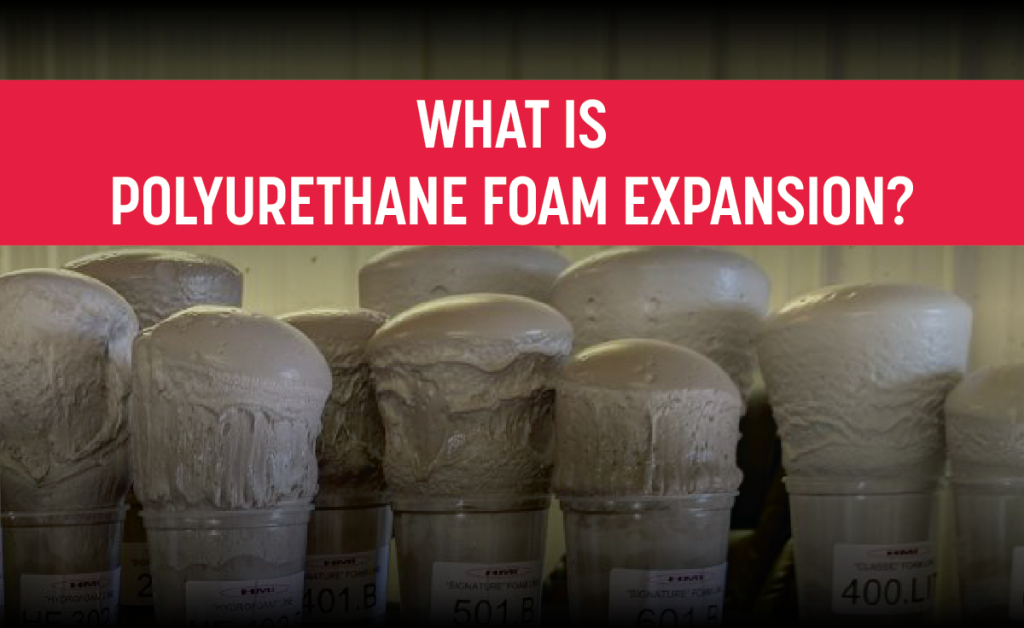
If you work with polyurethane foam for concrete lifting, you hear the word “expansion” all the time. A foam might be described as having 10x expansion, 15x expansion, or another expansion ratio. But what does that number actually tell you?
At its simplest, expansion describes how much the polyurethane increases in volume as the liquid components react and become foam. For contractors, that matters because expansion directly affects how much finished foam can be produced from the material being pumped.
From Liquid to Foam
Polyurethane concrete lifting systems typically begin with two liquid components that are pumped separately and mixed at the point of injection. Once mixed, a chemical reaction begins.
During that reaction, gas is generated or released within the reacting material, creating the cellular structure we recognize as polyurethane foam. The material increases dramatically in volume as it reacts and eventually cures into a rigid foam. That increase in volume is what we’re talking about when we discuss expansion.
What Does 10x Expansion Mean?
An expansion ratio gives us a simple way to describe the change in volume. If a polyurethane system has approximately 10x expansion, that means the finished foam can occupy roughly 10 times the volume of the initial mixed liquid under the conditions used to measure it.
Conceptually: 1 gallon of mixed liquid can produce approximately 10 gallons of expanded foam.
That does not necessarily mean a contractor will get exactly 10 gallons of usable foam in every field condition. Temperature, confinement, moisture, equipment settings, and other factors can influence how a polyurethane system reacts. But the expansion ratio gives us a useful way to understand and compare how much a formulation grows during its reaction.
Why Do Contractors Care About Expansion?
For contractors, expansion is closely connected to one very important thing: yield.
Yield is essentially how much finished foam you can produce from a given amount of material. If a formulation produces more finished volume per pound or gallon of chemical, that material can potentially address more void space. And that directly affects job costing.
Think about two formulations that require different amounts of material to produce one cubic yard of finished foam. If one requires about 100 pounds of material and another requires about 120 pounds to produce a similar finished volume, that difference matters when estimating a project. Over a small residential job, the difference may not seem enormous. Across thousands of square feet or many projects throughout the year, it can become significant.
Expansion Is Part of the Estimating Equation
This is why understanding expansion isn’t just chemistry trivia. It’s a business issue.
When estimating a polyurethane job, contractors need some idea of how much material will be required to create the amount of finished foam needed beneath the slab. That’s why estimating systems often use assumptions about pounds of material per cubic yard of finished foam.
For example, a contractor may estimate a particular formulation at approximately 100 pounds per cubic yard and another at approximately 120 pounds per cubic yard. Those numbers can then be adjusted based on the formulation being used, project conditions, and the contractor’s experience. The better you understand the yield of the foam you’re using, the better you can understand your material costs before you start pumping.
Expansion and Density Are Related
This also connects back to the foam densities we’ve discussed in the previous articles. Different polyurethane formulations are designed to produce different cured densities and physical properties.
A formulation that produces more finished volume from a given amount of material will generally result in a lower-density cured foam than a formulation producing less volume from a similar material mass. That’s one reason density and expansion are closely related.
But remember: different-density foams are different formulations. It’s not simply a matter of taking the exact same foam and “turning the expansion up or down.” Manufacturers formulate polyurethane systems to achieve a particular combination of cured density, expansion, reaction characteristics, and other physical properties.
What Expansion Doesn’t Tell You
Expansion is useful information, but a bigger expansion number isn’t automatically better.
Higher expansion can mean more finished foam from the material you’re purchasing, which is obviously attractive from a yield and job-costing standpoint. But there’s another side to that equation.
As formulations produce more finished volume, the density and physical properties of that cured foam also change. So while one formulation may give you more yield, another may be designed to produce a denser, stronger finished foam.
Neither is automatically better. It’s a tradeoff – and understanding that tradeoff is important when choosing foam for different applications.
The Bottom Line
Polyurethane expansion describes the increase in volume that occurs as the liquid components react and form cured foam.
For contractors, expansion matters because it’s closely tied to yield – how much finished foam can be produced from the material you’re purchasing and pumping. More finished volume can mean better material efficiency, which makes expansion an important part of estimating and job costing.
But that raises an important question: If more expansion gives you more yield, why wouldn’t you always want the foam that expands the most?
Stay Tuned
That’s exactly what we’ll cover next. In the next article in our Foam Fundamentals series, “Why More Expansion Isn’t Always Better,” we’ll look at the relationship between yield, cured density, and strength – and why getting more finished foam isn’t the only consideration when choosing a formulation. Check it out here.
This is blog #3 of the series, check out blogs #1 and #2 here: