Polyurethane foam is a trusted solution for engineers tackling soil stabilization and load capacity challenges across highways, bridges, industrial slabs, foundations and grain storage facilities. Injected as a liquid that expands and cures into a dense, load-bearing material, polyurethane delivers predictable compressive strength, controlled lift precision and rapid return to service.
This guide breaks down polyurethane’s engineering properties and applications, with case studies showing how it performs in the field.
Understanding the Geotechnical Properties of Polyurethane Foam
Polyurethane foam’s geotechnical properties make it effective for various advanced void filling solutions.
Compressive Strength
The high-density polyurethane load capacity of HMI RR401 provides robust support for the distributed bearing pressure requirements generated by AASHTO H-20 highway traffic loads (16,000-pound wheel loads). RR401’s high compressive strength meets DOT specifications for slab stabilization and lifting.
Material Density and Sub-Surface Stress
When a concrete structure experiences differential settlement, you need to address the root cause. It usually isn’t the concrete at fault. Instead, it’s caused by water-driven mechanisms like erosion, shrink-swell cycles or poorly compacted fill.
When soils are already failing due to these mechanisms, using a lighter material can be appropriate. HMI RR401 typically weighs only 4 pounds per cubic foot. Polyurethane can lift concrete slabs without restressing a weak subgrade. This capability provides a lasting solution because you’re adding much less weight to the subgrade than with other methods.
The Washout Factor
Hydrophobic foam specifications suit projects in high-water tables. Poly foam displaces water and cures rigidly even in wet environments with hydro-insensitive formulations. This reaction doesn’t dilute when you inject it into wet soil. Instead, it pushes the water out of the way and cures hard.
Elasticity
When specifying materials for dynamic environments like highway approach slabs, you’ll likely need your fill material to have some elasticity. High-density polyurethane provides a network structure that acts as a shock absorber, flexing with the slab under dynamic loads with less tendency to fracture.
Crucially, polyurethane holds up over thousands of repeated cycles in dynamic load testing. During testing, the foam-reinforced soil experienced less settlement and deformation, and researchers estimated a service life of at least 60 years based on comparative durability results.
Cure Time and Downtime
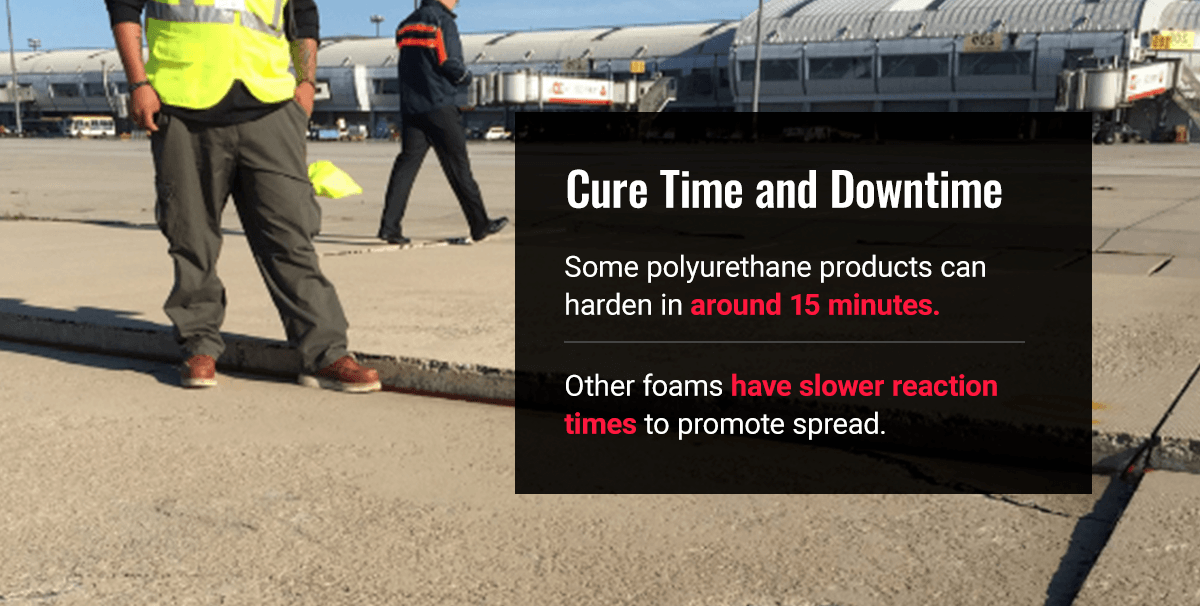
When you need to stabilize concrete fast, some polyurethane products can harden in around 15 minutes. Other foams have slower reaction times to promote spread.
Polyurethane Applications
From soil stabilization to void filling, polyurethane is a versatile material for many commercial and municipal projects.
Deep Injection for Soil Compaction
Treat unstable soils at their source using Deep Foamjection™. The foam follows the path of least resistance to create a stronger foundation by filling voids and binding loose soil particles together. By injecting the foam deeper into the ground or under a slab, it fills fissures and ground voids, displaces collected water and increases the subgrade’s load-bearing capacity. The result is lasting repair, as the cured foam does not change shape or absorb groundwater.
Joint Stabilization
RR501 polyurethane foam can stabilize joints, making it an ideal solution for applications ranging from residential concrete to DOT infrastructure repair. The foam prevents rocking slabs and faulting at joints by displacing any trapped water and filling voids.
As it cures, polyurethane foam hardens into a high-density, solid waterproof structure, sealing the joint from the underside and consolidating any loose base material. With the void filled and the base stabilized, the slab no longer deflects under load.
Soil Nailing and Slope Reinforcement
You can use polyurethane foam as the high-strength bonding medium between the soil and steel soil nails for excavation support and slope reinforcement. With the fast curing time, excavation can continue quickly after installing soil nails, speeding up project timelines. Crucially, polyurethane can perform in difficult soil conditions. In pull tests, polyurethane foam has exceeded the yield strength of the steel bar, demonstrating its high-strength bond.
Real-World Applications
When projects involve weight restrictions, active traffic or high-water tables, polyurethane provides an effective solution. Here are some examples of how project constraints led to the use of poly foam.
The Highway 1 Stabilization
A 300-foot section of Highway 1 was experiencing severe faulting due to poorly compacted fill at depths of 3-12 feet. A full shutdown to excavate and rebuild the road was not an option, as it would cause hours of delays for commuters between LA and San Francisco. Instead, contractors injected HMI HF 402 polyurethane under the failing road, lane by lane. This strategy allowed them to stabilize the soil below without removing any pavement. They completed the project in 15 days, using 37,800 pounds of material while minimizing impact on the local community through single-lane closures.
The GeoFoam Bridge Lift
A bridge approach ramp became too steep, creating a pronounced vertical discontinuity at the hinge point where the asphalt met the bridge deck. While the deck sat on piles, the approach ramp rested on settling fill. As the slope was already failing, adding heavy mudjacking material wouldn’t have been a lasting solution. The other option of removing the concrete, rebuilding the grade and repouring a section of the bridge would’ve been more expensive and impacted traffic.
Engineers used 19.5 cubic meters of high-density polyurethane to lift the approach slab. The poly foam filled the void and lifted the slab without adding significant dead weight to the failing slope.
This project was completed in just two days.
Grain Bin Stabilization and Raising
The subgrade beneath a 150,000-bushel grain bin needed stabilizing because it couldn’t support the bin’s 4,600-ton weight. The slab beneath the grain bin needed to be lifted 6 inches. The alternative repair methods, like demolition and construction, were estimated to cost $1 million or more. Time was also a key factor in this project, as harvest season was approaching.
HMI worked with contractors to provide a solution using multiple polyurethane formulations. First, contractors used HF402 to stabilize the subgrade. It has a slower reaction profile, allowing the foam to penetrate further. HF402 can also withstand high loads of up to 17,856 pounds per square foot. The grain load at full capacity was 2,441 pounds per square foot.
After stabilizing the subgrade, contractors used HF402 Fast and RR401 to lift the slab by 5 inches. The work took five days but saved months of downtime and hundreds of thousands of dollars.
Why Partner With HMI?
With over 50 years of experience, HMI is an industry-leading concrete raising manufacturer. Whether you need advanced void filling equipment or dependable polyurethane foam, we can help you maximize the efficiency of your project. We continuously research and innovate to develop the most effective tools on the market.
We also offer end-to-end engineering support as part of our services, from project planning through to on-site support.
Choose HMI’s RR401 Polyurethane Foam for Faster, Stronger Concrete Repairs
Evaluating polyurethane soil stabilization specs for your next project is crucial to filling voids and stabilizing subgrades. Polyurethane can be a versatile solution for projects requiring weight-restricted soils, fast cure times or wet environments.
Read about our RR401 4lb Concrete Raising Foam or contact us for more engineering specifications.